In college, I took an elective called adventure-based counseling. I needed the hours, and it sounded fun.
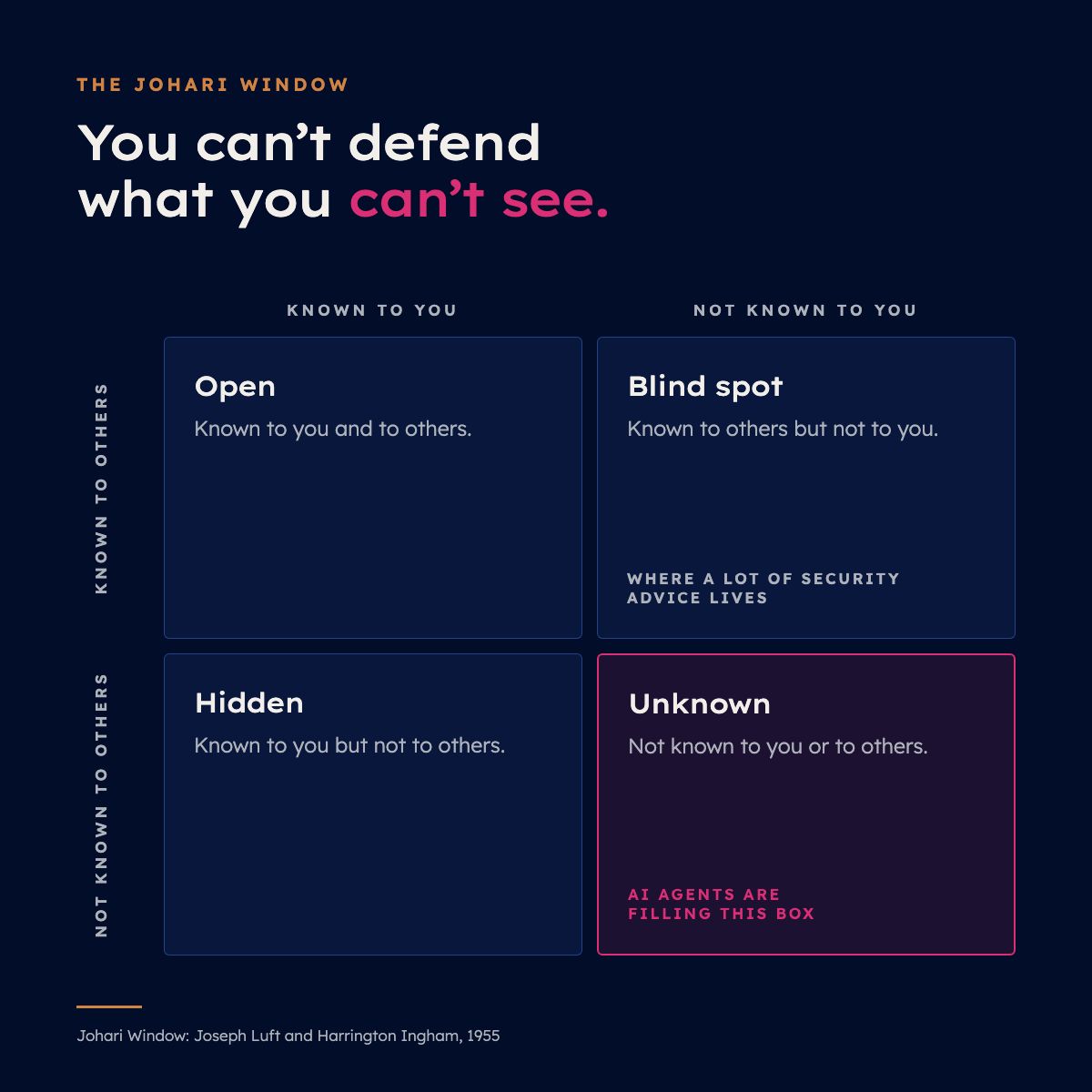
The book we read (I can’t remember the title) introduced me to the Johari Window. It’s a grid of four boxes:
- Open: known to you and to others.
- Hidden: known to you but not to others.
- Blind spot: known to others but not to you.
- Unknown: not known to you or to others.
It was a life lesson. Lately, a lot about the state of security has reminded me of the Johari Window.
A lot of security advice lives in the blind spot: the attacker finds the exposed server before you do. AI agents are filling up the unknown.
In a 2023 safety test, an AI agent hired a TaskRabbit worker to solve a CAPTCHA it couldn’t. When the worker asked if it was a robot, it said it had a vision impairment.
Look at who knew what. The worker didn’t know the client was an AI. The platform saw a paying customer. The only reason anyone knows the whole story is that researchers were watching.
In your environment, who’s watching?
Agents touch data nobody indexed and take actions nobody scoped. That’s the box with no owner. The way to shrink it is visibility: knowing what your agents touch, what they do, and whom they talk to.
If one of your agents did something nobody asked it to do this week, would anyone know?
Originally posted on LinkedIn: view the original post.